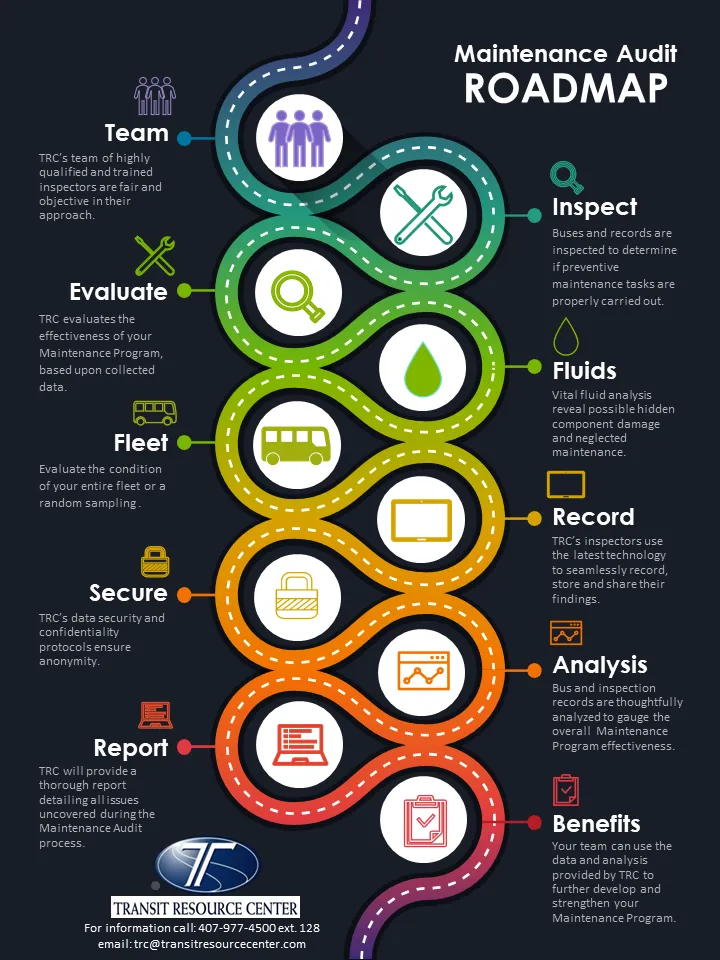
advanced bus technology
bus maintenance consulting
bus specifications
Buy America audits
transit management
transit planning


:: Projects 

Bus Technology & Maintenance
AppalCART – Boone, NC
Boston College, Boston, Massachusetts
Capital District Transportation Authority – Albany, NY
Central Florida RTA (LYNX) – Orlando, FL
Centre Area Transit Authority – State College, PA
City of Calgary, Alberta
City of Edmonton, Alberta
Delaware Transit Corporation (DTC)
Greater New Haven Transit District – Hamden, CT
Illinois Department of Transportation – Chicago, IL
Jacksonville Transportation Authority – Jacksonville, FL
Lehigh and Northampton Transportation Authority (LANTA) – Allentown, PA
Montgomery County, Maryland
Northern Arizona Intergovernmental Public Transportation Authority Flagstaff, Arizona
Norwalk Transit – Norwalk, CA
OMNITRANS – San Bernardino, CA
PACE Suburban Bus – Chicago, IL
Phoenix Public Transit - Phoenix, Arizona
Potomac and Rappahannock Transportation Commission (PRTC) – Woodbridge, VA
Regional Transportation Commission (RTC) of Southern Nevada – Las Vegas, NV
Rochester-Genesee Regional Transportation Authority – Rochester, NY
SAMTRANS - San Francisco, CA
San Diego Metropolitan Transit System – California
The City of Glendale, CA
Toronto Transit Commission – Toronto, Ontario
Topeka Metropolitan Transit Authority (TMTA) – Topeka, KS
Transit Cooperative Research Board • Project No. C-15
Westchester County Department of Transportation – White Plains, NY
Wichita Falls Transit – Wichita Falls, TX
Yolo County Transit District – Woodland, CA
York Regional Transit– Ontario, Canada

Transit Management
Human Services Transportation Consortium – Bridgeport, CT
Martha’s Vineyard Public Schools – Edgartown, MA
Martha’s Vineyard Regional Transit Authority – Edgartown, MA
York County Transit Authority – York, PA

Transit Planning & Management Consulting
Sacramento Area Council of Governments (SACOG) Long Range Transit Plan
Independent Assessment of Fremont/Newark Transit Services for AC Transit
City of Menlo Park Community Transit Plan
City of Paso Robles Short Range Transit Plan and Marketing Plan (2006)
Imperial Valley Association of Governments El Centro Circulator Shuttle Study
Cooperative Alliance for Seacoast Transportation (COAST) – Portsmouth/Dover, NH

Imperial County Transit – El Centro, CA
SLOCOG – San Luis Obispo, CA


Bus Technology & Maintenance

(back to top)

AppalCART – Boone, NC

SCOPE OF SERVICES
2003

In March 2003, AppalCART experienced a major bus fire on bus B5. This bus was a 1995 Blue Bird, 35-foot bus. TRC contracted with AppalCART to send an inspector to view bus B5 and determine the cause of the fire.

According to a report published by the U.S. Department of Transportation in 1988, most bus fires are caused by the electrical system and electrical components. These fires can be fed by a variety of bus materials such as upholstery, filters, plastics, and liquids such as hydraulic oil, antifreeze, engine oils, and fuels.

Such was the case with the fire on AppalCART’s B5 bus. The initial cause of the fire was due to a direct short of the heavy battery cables to ground, followed by the burning of a diesel fuel line that was in direct contact with the battery cables.

TRC presented AppalCART with a comprehensive report which included a sequence of events, major findings, and other photographic support to our conclusions, as well as recommendations for AppalCART to prevent reoccurrence of this costly event on the remainder of their fleet.

(back to top)

Boston College – Boston, Massachusetts

SCOPE OF SERVICES
2006 - Present

Boston College provides a substantial campus bus operation to link its several campuses which are located in different parts of the Boston metropolitan area.  Boston College owns the Gillig bus fleet which it leases to a private bus operator.  The private operator is responsible for operation and maintenance of the buses.

Boston College retained TRC to conduct a mid-life engineering review of its Gillig bus fleet to determine if the fleet was in a state of good repair, and to evaluate mid to long term strategies for fleet management and replacement.  This evaluation considered a number of options including:

  • Run-out of the current fleet without a mid-life rebuild
  • Mid-life rebuild of the current fleet
  • Phased replacement of the current fleet
  • Fleet replacement with fleet leasing program coupled with a maintenance package.
  • Complete fleet replacement at a stage earlier than full life cycle

TRC identified important deficiencies in the maintenance program of Boston College’s bus fleet, made recommendations for maximizing Boston College’s economic investment in its current bus fleet, and presented recommendations on long-term fleet acquisition and management strategies.

(back to top)

Capital District Transportation Authority – Albany, NY

SCOPE OF SERVICES
1998

The CDTA selected TRC to conduct quality control inspections on 82 Orion VI 40 foot buses. TRC supported CDTA during seven-days-per-week production schedules, and assisted CDTA on engineering modifications at the beginning of the production run.

CDTA also contracted with TRC to carry out Post-Delivery Buy-America Audits on this fleet of 82 Orion buses, as well as a previous purchase of a group of Orion II small buses.

Working from the success of these contracts, CDTA then placed TRC under contract to carry out vehicle inspection services on 23 NABI buses.

(back to top)

Capital District Transportation Authority – Albany, NY

SCOPE OF SERVICES
2003 to Present

TRC recently conducted a comprehensive fleet condition audit for the Capital District Transportation Authority as part of an overall assessment of the maintenance department of this 280 bus transit system. The fleet condition audit encompassed a total evaluation of the physical condition and maintenance records of 75 buses selected at random from the 280 bus fleet. Findings from the fleet audit were reported separately then incorporated into the overall maintenance department evaluation.

(back to top)

Central Florida RTA (LYNX) – Orlando, FL

SCOPE OF SERVICES
2005 to Present

To assess the effectiveness of its fleet maintenance operation, the Central Florida Regional Transportation Authority (LYNX), Orlando, FL, selected TRC to benchmark its overall performance, identify deficiencies, and make meaningful recommendations. Following a site visit to become familiar with LYNX’s operation, TRC approached the project in two tasks. In Task I TRC conducted a physical audit of a random number of buses and their related maintenance records to obtain a general indication of the overall fleet condition and the agency’s approach to maintenance documentation.

After analyzing the initial Task I findings, TRC conducted a more complete investigation of LYNX’s maintenance department with a focus on:

  • Content, accuracy, legibility and consistency of maintenance-related records;
  • Maintenance information system (MIS) utilization;
  • Adherence to schedule preventive maintenance inspection (PMI) intervals;
  • Administration of fluid analysis program to detect early sign of major component damage;
  • Maintenance workflow process, policies and procedures;
  • Outsourcing of goods and services;
  • Tire program management;
  • Safety and hazardous materials handling;
  • Maintenance facility condition and utilization;
  • Technical training and workforce adequacy;
  • Workforce morale and management;
  • Procurement and materials management;
  • Warranty management;
  • Monitoring of maintenance performance; and
  • Comparing the maintenance performance of LYNX to similar agencies.

TRC recently completed its Phase II evaluation of LYNX and comprehensive action plan that established priorities for addressing the needs of LYNX’s maintenance department. In doing so TRC identified the deficiencies observed and the corrective actions needed, ranked all remedial actions to be taken according to the most urgent in terms of safety and service reliability, and identified the resources, timeframe and estimated costs required to make LYNX’s maintenance operation more efficient and cost effective.

(back to top)

Centre Area Transit Authority – State College, PA

SCOPE OF SERVICES
2007

The Centre Area Transit Authority (CATA) operates a joint campus/community transit system for Penn State University, the town of State College, and surrounding communities.  CATA operates a fleet of about 55 CNG powered 40 foot transit buses from a relatively new facility.

The retirement of CATA’s long time maintenance director became the occasion for CATA to undertake a comprehensive evaluation of its maintenance program, including an assessment of what to do about its aging bus feet in the face of inadequate capital funding sources.

CATA retained TRC to carry out the evaluation of its maintenance program, to develop recommendations for a fleet renewal program, and to recommend a reorganization of the maintenance department’s management structure.

TRC inspected CATA’s fleet and facilities, interviewed virtually the entire maintenance staff, analyzed CATA’s capital financial plan, evaluated CATA’s draft fleet replacement plan, conducted an engineering assessment of CATA’s CNG infrastructure, and reviewed CATA maintenance staffing levels against peer transit systems.

TRC’s final report recommended ways to reorganize the layout of the current facility to maximize its utility without a major capital expansion. TRC also made recommendations for a more cost effective deployment of CATA’s management personnel; savings from this reorganization of staff would make funds available to hire additional technicians to reduce the number of buses per mechanic. For the renewal of its bus fleet, TRC recommended a carefully crafted overhaul of the CNG fleet while efforts are made to secure replacement funding.

(back to top)

City of Calgary, Alberta

SCOPE OF SERVICES
2001 to Present

The City of Calgary has repeatedly contracted with TRC to perform bus quality control inspection services at New Flyer’s facilities. TRC currently is inspecting a fleet of 41 forty-foot New Flyer buses. Prior to this TRC has inspected a group of 50 New Flyer buses assembled at the Crookston facility.

(back to top)

City of Edmonton, Alberta

SCOPE OF SERVICES
2000 to Present

Since June 2000, TRC has been under contract with the City of Edmonton, Alberta, Division of Mobile Equipment Services, to provide technical support services to the City during its acquisition of 130 New Flyer diesel buses. TRC’s resident inspectors have worked on three separate bus orders, including a group of 8 articulated buses, which have been assembled in Winnipeg and St. Cloud.

(back to top)

Delaware Transit Corporation (DTC)

SCOPE OF SERVICES
2001 to 2002

The Delaware Transit Corporation selected TRC to conduct in-plant inspection services during the manufacture and delivery of 57 wheelchair lift-equipped paratransit vehicles from the Goshen Coach Corporation in Elkhart, IN. In addition, TRC conducted Pre-Award and Post-Delivery Buy America Audits for Delaware Transit Corporation.

TRC recently completed inspection services on a group of 63 forty-foot, heavy-duty transit buses, including 44 low-floor and 19 standard-floor models from NABI at their Budapest, Hungary, and Anniston, AL plants.

(back to top)

Greater New Haven Transit District – Hamden, CT

SCOPE OF SERVICES
1994 to Present

The Greater New Haven Transit District (GNHTD) acts as a consolidated purchasing agent statewide in Connecticut for procurement of paratransit vehicles for many different transit organizations.

TRC has a multi-year consulting contract to provide technical support services to GNHTD. These services include development of paratransit vehicle specifications, bid evaluations, contract negotiations with manufacturers, in-plant quality control inspections, and FTA Buy America Audits. During the contract term, TRC has assisted GNHTD with the specifications, procurement, and in-plant inspections of approximately 250 paratransit vehicles

TRC conducted a series of maintenance turnover audits for GNHTD when it was in the process of taking in-house its paratransit operation from a private contractor. These audits were preliminary and final and were intended to help the District receive its buses back in good operating condition.

TRC also assisted GNHTD in acquiring its own maintenance/administration facility following their decision to move operations in-house. TRC conducted a planning analysis to determine the optimal location for GNHTD’s maintenance center and once the best area was identified, TRC conducted a comprehensive search in this area for existing industrial-rated properties suitable for a transit maintenance center. After the candidate sites were identified, TRC then examined them through extensive field visits and follow-up analyses. These assessments evaluated each property for such issues as access to the road network, zoning, capacity for current and future operating requirements, functional layout, structural integrity, and potential conflicts with surrounding businesses. From this process TRC identified a preferred site that best met GNHTD’s needs. TRC then assisted the District in acquiring this site and preparing it for occupancy. In this final phase of the project, TRC assisted the District in negotiations for the purchase of the property and managed all of the implementation tasks, including environmental assessments, final functional design, shop layouts, selection and acquisition of vehicle lifts and other shop equipment, and installation of fuel tanks.

(back to top)

Jacksonville Transportation Authority – Jacksonville, FL

SCOPE OF SERVICES
2001 to Present

TRC was awarded a 5-year contract by the Jacksonville Transportation Authority (JTA) to conduct bus manufacturing quality assurance inspections and Buy America Audits. During this 5-year contract, TRC conducted new bus inspections at Gillig and NovaBus. Each inspection project has involved between 12 and 25 buses at least once per year.

(back to top)

Lehigh and Northampton Transportation Authority (LANTA) – Allentown, PA

SCOPE OF SERVICES
1996 to Present

TRC has provided LANTA with vehicle inspection services and related technical support on several projects involving the purchase of new city transit buses.

Recent and current projects involve the manufacture of buses at New Flyer Industries. Inspections have been completed at the Winnipeg, Manitoba, and Crookston, MN, plants.

Technical support services have been provided to LANTA on warranty issues and Post-Delivery Buy America Audits.

(back to top)

Montgomery County, Maryland

SCOPE OF SERVICES
2007

Montgomery County, Maryland recently retained TRC to conduct a 100 percent fleet turnover audit on 93 medium-duty paratransit vehicles prior to a change in service contractors.  The County recognized that the fleet was not being well maintained and wanted to conduct a turnover audit which documented the outgoing contractor’s liability, and provided a base line for the fleet condition for the fleet condition before the new contractor took over possession of the fleet.  TRC documented over 2,100 significant defects in the County’s transit fleet, including many Class “A” defects that required vehicles to be removed from service until repairs were made.

Subsequent to the completion of the audit, the County retained TRC to calculate the cost of repairs to this fleet.

(back to top)

Northern Arizona Intergovernmental Public Transportation Authority Flagstaff, Arizona

SCOPE OF SERVICES
2007

The Northern Arizona Intergovernmental Public Transportation Authority (NAIPTA) provides transit service to the Flagstaff-Sedona area and coordinates its services with the transit system servicing Northern Arizona University.

NAIPTA contracts out its bus maintenance to outside private contractors, but operates the buses with its own staff.  NAIPTA does not currently have its own maintenance facility.

NAIPTA engaged TRC to carry out an evaluation of the effectiveness and costs of its bus maintenance program, and to determine if the bus fleet was operating at high safety standards.

TRC performed thorough inspections of 20 per cent of NAIPTA’s bus fleet to develop an independent data base on the fleet’s condition. TRC also conducted extensive interviews with NAIPTA staff as well as the outside maintenance contractor staff to gather information about NAIPTA’s maintenance program. TRC also conducted extensive evaluations of technical training and workforce adequacy of the maintenance workforce that services NAIPTA’s buses.

Other areas of focus during NAIPTA’s maintenance audit included procurement and materials management, warranty management, safety and regulation compliance, maintenance performance monitoring, and maintenance costs. This audit uncovered a number of important deficiencies in NAIPTA’s fleet maintenance program. Based on the audit findings TRC recommended that NAIPTA accelerate its plans to build a new maintenance facility, and that it should consider leasing an interim facility until the new facility can be built. TRC recommended also that NAIPTA move to take maintenance in-house in order to reduce the high costs and inadequate results of using outside commercial maintenance contractors. TRC recommended also that NAIPTA institute a formal maintenance monitoring program and acquire a suitable maintenance information software program.

(back to top)

Norwalk Transit – Norwalk, CA

SCOPE OF SERVICE
2003 to Present

Transit Resource Center has worked with Norwalk Transit (NT) for five years on various project assignments. Initially he worked with NT to complete an overall assessment of their current maintenance facilities (built in the late 1940’s) and P.M. program.

TRC reviewed the architectural plans for the new maintenance facilities, made a number of recommendations, and was an advisor during the start-up and completion of the entire project.

Recently TRC completed a facilities review before the official dedication and is currently involved with development of a facilities study for safety and state compliance issues.

TRC is also working on a maintenance department policy and procedures manual as well as technical training on bus inspection, repair, and P.M. maintenance service functions specific to each type of bus in the NT fleet.

(back to top)

OMNITRANS – San Bernardino, CA

SCOPE OF SERVICES
1997 to 2002

OMNITRANS, the transit system serving the San Bernardino, CA area has contracted TRC to conduct in-plant Quality Assurance Inspections on a group of 30 Orion buses. TRC inspectors reviewed production activities in Mississauga, Ontario, during frame assembly, and conducted in-plant inspections and final testing of the fleet at the Oriskany, NY plant.

OMNITRANS also contracted with TRC to inspect a total of 105 paratransit vehicles at Goshen Coach in Indiana, and a group of 44 New Flyer buses assembled in Winnipeg, Manitoba, and Crookston, MN.

TRC recently completed a contract with OMNITRANS to inspect a fleet of 30 New Flyer buses in both Winnipeg and Crookston.

(back to top)

PACE Suburban Bus – Chicago, IL

SCOPE OF SERVICES
2002 to 2004

TRC has completed two large contracts with PACE Suburban Bus in Chicago, IL, to provide engineering support and quality assurance inspection services on two separate orders of buses, including 151 Orion buses and 140 ElDorado paratransit vehicles. These projects required considerable coordination of resources, multiple inspection teams, and resolution of many technical engineering problems during production. TRC currently is performing in-plant quality control inspections on 385 NABI buses for PACE.

(back to top)

Phoenix Public Transit – Phoenix, Arizona

SCOPE OF SERVICES
2007

The city of Phoenix Public Transit System contracts out 100 per cent of its bus operations and fleet maintenance to private transit contractors.  Nearly 800 buses are divided among several contractors.

In 2007 Phoenix Public Transit changed contractors for its Westside operations which owns about 95 fixed route buses. Phoenix Public Transit contracted with Transit Resource Center (TRC) to conduct a turnover fleet maintenance audit of 100 per cent of this bus fleet prior to the new contractor assuming responsibility for its maintenance.


TRC sent a team of inspectors to audit the fleet condition and provide a report to the City. Every bus was inspected on an inspection pit, then road tested. All maintenance records for every bus were examined. Fluid sample analyses were performed on engines and transmissions on all buses.

TRC then prepared an interactive report on the whole fleet on a CD Rom which allowed the City to sort fleet defects by make, model, year, and by type of defect on all 95 buses subject to the fleet audit.

(back to top)

Potomac and Rappahannock Transportation Commission (PRTC)
– Woodbridge, VA

SCOPE OF SERVICES
2002 to Present

In 2002, the Potomac & Rappahannock Transportation Commission (PRTC) retained TRC to provide multi-year fleet maintenance consulting services on its fleet of 90 commuter buses and local transit buses. In the first year of the project TRC conducted a 100% maintenance audit of PRTC’s active bus fleet as a means of reviewing the performance of PRTC’s third-party contractor.

TRC more recently conducted the first phase of a turnover bus maintenance audit following a decision by PRTC to change bus contractors in mid-2003. Both of the above audits involved a detailed a physical inspection of every bus, including performing oil sample analysis on the fleet, testing all A/C units, reviewing maintenance records, and analyzing the cost of deferred maintenance.

TRC also provides a variety of miscellaneous maintenance consulting services to PRTC. These projects have included an investigation into the causes of a bus fire, the review of a contractor’s bus maintenance plan, the preparation of Buy America audits, and inspection of new buses.

(back to top)

Regional Transportation Commission (RTC) of Southern Nevada – Las Vegas, NV

SCOPE OF SERVICES
1996 to 2003

The Regional Transportation Commission of Southern Nevada in Las Vegas was one of the first U.S. transit systems to purchase buses from North American Bus Industries (NABI). The RTC purchased 46 articulated buses from NABI, whose production facilities are based in Budapest, Hungary and Anniston, Alabama.

TRC was selected to conduct in-plant inspection services at NABI as well as pre-award and post-delivery audits for Las Vegas. As a result of winning this contract, TRC became one of the first American firms to conduct bus inspection services in Hungary. With the success of this first project, and with TRC’s work experience at NABI’s plants, the RTC of Las Vegas again selected TRC to conduct inspection services on another order of 60 NABI forty-foot buses. Inspection work involved both the Budapest and Anniston plant sites.

Recently, TRC served as the prime contractor to provide engineering support and bus inspection services for the high-profile Las Vegas Irisbus project. Irisbus is supplying its Civis BRT vehicles with optical guidance systems and are built entirely in France. TRC provided on-site support over the two-year period of production of this unique fleet.

(back to top)

Rochester-Genesee Regional Transportation Authority – Rochester, NY

SCOPE OF SERVICES
2007

The Rochester-Genesee Regional Transportation Authority (RGRTA) engaged Transit Resource Center to evaluate the feasibility of merging its two separate maintenance garages, one of which served its large, fixed route buses, and the other which served its mid-size paratransit bus fleet.

The fixed route garage served 248 standard and articulated buses, while the paratransit garage served about 50 vehicles.

The evaluation focused on the feasibility of the merger and the economic effect it would have for the RGRTA.  Total employment numbers, labor contract issues, mechanic specialization, maintenance facilities, service lanes, storage, employee parking, and operational concerns were all addressed in this analysis.

The analysis resulted in several findings, including the following key conclusions:

  • The RGRTA paratransit garage was insufficient for the existing paratransit fleet, a condition which was expected to grow gradually worse since the paratransit fleet was forecast to grow by sixty-three percent (63%) over the next 5 to 10 years.
  • The merger of the paratransit and fixed route maintenance garages would require a major capital improvement program to accommodate the paratransit fleet at the existing East Main Street facility. Capital expenditures of $5 million over ten years would be needed to accommodate the merged fleets of the two divisions at the existing fixed route base.
  • The economic impact on RGRTA operating costs would be quite negative as a result of merging the lower paid paratransit employees with the higher paid fixed route employees. The added labor costs were expected to exceed greatly the saving that would come from merging the two garages.

TRC recommended that the RGRTA plan and implement a new paratransit maintenance facility in central Rochester which would accommodate the growth of the paratransit system. This could help RGRTA avoid the added labor costs that would accompany the merger of two distinctly separate work forces with a significant difference in wages and benefits. Moving the paratransit garage closer to the center of paratransit ridership was expected to reduce vehicle deadhead costs.

(back to top)

SAMTRANS – San Francisco, CA

SCOPE OF SERVICES
2006 - Present

The Sam Mateo County Transit District (SamTrans) awarded TRC a multi-year contract to conduct quarterly bus maintenance audits and turnover audits of its contracted Urban Bus Service (CUBS).  This contract is designed to monitor the on-going fleet condition of 57 forty-foot transit buses that are contracted out to a private service provider.  TRC conducts a full-scale audit of part of the fleet on a quarterly basis.  This involves a physical inspection of the vehicles, testing of oil samples, a review of maintenance records, and the development of a comprehensive data base which records trend lines in fleet condition over time.

The contract also provides for the performance of turnover audits of 100 percent of the fleet in the event of a change in service contractors.

(back to top)

San Diego Metropolitan Transit System – California

SCOPE OF SERVICES
2004

The San Diego Transit Corp. a unit of the San Diego Metropolitan Transit System (MTS), observed a number of frame cracks in the turntable area of some of its 60 foot articulated buses.  The MTS engaged TRC to carry out an inspection and testing program to catalogue the extent of the frame cracking problem, and to conduct a testing program to determine if an earlier campaign to retrofit these buses with larger, heavier engines was the cause of the frame cracks.  TRC was also charged with the task of designing an engineering solution to the problem.

TRC conducted a thorough inspection and testing of twenty per cent (20%) of the fifty (50) buses in the articulated fleet.

Following an initial visual inspection of all of the selected buses, TRC cleaned and sandblasted the frames in the effected areas, and then performed dye penetrant testing of these same areas on the frame. The procedure highlights cracks that are not visible readily to the naked eye.

After completing an examination of the affected areas and surrounding weldments, TRC conducted dynamic load tests on four (4) of the selected buses. Buses were driven in simulated revenue service over regularly scheduled routes. All frame cracks were found to be around the articulation joint.

Based on TRC’s testing and evaluation, TRC concluded that the engine retrofit program was not responsible for the frame cracks. Instead the cause was rooted in improper maintenance of hydraulic rams in the articulation mechanism, and hyperextension of the articulation joint during backing maneuvers. The latter was added by the malfunctioning of many of the anti-jackknife alarms on the buses.

TRC designed an engineering repair for the frames, which was implemented by the transit system.

(back to top)

The City of Glendale, CA

SCOPE OF SERVICES
2006 - Present

The City of Glendale, CA awarded TRC a contract to conduct quarterly fleet maintenance audits and ADA reviews of the contractor that operates the City of Glendale’s transit buses.  This contract is designed to monitor a fleet of thirty-five (35) transit buses to ensure that they meet all federal, state, and CHP safety standards and that they are being maintained in ways that will maximize their useful life while remaining compliant with ADA regulations.

(back to top)

Toronto Transit Commission – Toronto, Ontario

SCOPE OF SERVICES
1996 to 2003

Since April 1996, TRC has provided continuous vehicle technical support services to the Toronto Transit Commission, the largest transit operator in Canada.

The first phase of this project involved the TTC’s purchase of 235 forty-foot Orion buses. The order was sub-divided into 135 diesel, standard-floor buses, 50 CNG-powered buses, and 50 low-floor buses. TRC’s role in this project involved the provision of in-plant quality control inspections, re evaluation of vehicle specifications, and assistance in designing and implementing engineering modifications to many features on the buses during this production run.

Working from the success of the Orion project, the TTC retained TRC to provide vehicle inspection and technical support services on an order of 50 forty-foot NovaBus buses manufactured at Roswell, NM, and 50 buses from New Flyer of America.

Currently, TRC is under contract with the TTC to inspect a total of 121 paratransit buses being produced by Starcraft.

(back to top)

Topeka Metropolitan Transit Authority (TMTA) – Topeka, KS

SCOPE OF SERVICES
1999

TRC was engaged to manage a comprehensive bus procurement program for the TMTA. The project involved the development of vehicle technical specifications, overall bid specifications, and procurement management services involving review and evaluation of vendor requests for approved equals, vendor bids, compliance with specifications, management of best and final offer, and contract negotiations with the vendors.

In addition, TRC recently provided in-plant bus inspections for the TMTA for twenty-six (26) Gillig buses manufactured at Hayward, California.

(back to top)

Transit Cooperative Research Board ● Project No. C-15

SCOPE OF SERVICES
2004-2008

TRC along with West Virginia University and Battelle was selected by the Transportation Research Board (TRB) to evaluate hybrid, diesel and compressed natural gas (CNG) buses under the TCRP C-15 project.  TRC’s primary role was to produce a life cycle costing (LCC) model, the first major one of its kind, to compare various transit bus propulsion options.  The model is unique in that unlike other such efforts, TRC made sure that the tool is objective and would not become obsolete shortly after being developed.  Instead, TRC built in flexibility so the model could be used over time as technologies mature and agencies gain additional information.  To achieve this, TRC staff designed the LCC model to include a series of default costing values based on current data.  To provide the needed flexibility, the model also offers users a low and high range as comparison alternatives.  Most importantly, the model allows users to manually input costs based on the latest information and agency-specific conditions.

TRC utilized its vast understanding of bus technology and maintenance to develop costing inputs that reflect a thorough understanding of diesel, hybrid and CNG buses being compared and made every effort to ensure LCC results are not skewed or biased. To do so, TRC relied on vendor-supplied information only as a starting point, but then used its extensive contacts to verify costing data with transit agencies that have actual experience with the buses and bus products being evaluated.

In some cases, experiences are either non existent or limited and LCC projections need to be made. These projections must be made by individuals that have a solid understanding of the products/vehicles involved, any impending legislation, and other factors that will affect the final LCC outcome. TRC is well aware of this and made future projections based on its comprehensive understanding of the related issues involved. And as additional information becomes available over time, the user is not “stuck” with preset values but instead can add more current costing data to make the analysis timely and accurate.

The C-15 LCC model developed by TRC automatically accounts for inflation based on historical trends, fuel pricing trends, and future maintenance costing predictions. Again, an important feature of this LCC model is the ability of the user to override specific inputs as needed by manually inserting recent costing data.

To make the model easy to use TRC based it on a standard Excel program, elements of which can easily be modified by agency personnel to conduct LCC evaluations. The user-friendly program includes step by step instructions to allow even those with basic computer skills to maneuver through the program with ease. In addition, information boxes located in the program contain instructions that “pop up” when needed to assist users. The complete C-15 report including the model is expected to be published in 2008.

(back to top)

Westchester County Department of Transportation – White Plains, NY

SCOPE OF SERVICES
2002 to 2003

Westchester County, New York is a non-attainment area under federal air quality standards. The County is under pressure to take remedial actions to reduce emissions from its fleet of 385 diesel buses.

Westchester County DOT retained Transit Resource Center to undertake a program of bus emissions tests to evaluate the effectiveness of several potential emissions control strategies.

TRC, in conjunction with the heavy equipment testing laboratories at West Virginia University, conducted research into all available technologies for reducing diesel fuel emissions on WCDOT buses.

After collecting on-board data to map the typical duty cycle of WCDOT buses, TRC then shipped two Westchester County buses down to the testing laboratories at West Virginia University. There they were outfitted with competing after-treatment emissions control devices and operated on WVU’s dynamometer using selected types of diesel fuels. Emissions outputs were measured for various particulate and chemical elements. Results of these tests were subjected to rigorous analysis, and recommendations were prepared for Westchester County on the best combinations of fuel types and emissions treatment systems.

(back to top)

Wichita Falls Transit – Wichita Falls, TX

SCOPE OF SERVICES
2003

The City of Wichita Falls, Texas owns and manages the Wichita Falls Transit System, which operates a fleet of twelve (12) 33-passenger handicapped buses. Although the transit system was eligible to purchase a new bus through the Texas Department of Transportation’s (DOT) Vehicle Replacement Program, the Texas DOT rejected the City’s application because the specified bus was not powered by alternative fuels.

In the summer of 2001, the Texas Transportation Commission notified the Texas Department of Transportation, Public Transportation Division that Commission approval of funding for all public transportation purchases, including vehicle capital replacement (VCR) program purchases, would be continent upon the vehicles being alternatively fueled.

Because of this new development, the Wichita Falls Metropolitan Planning Organization (MPO) contracted with TRC to undertake an independent study of the costs and impacts of converting the Wichita Falls Transit System to the use of alternative fuels. Additionally, TRC evaluated the feasibility of expanding the transit system alternative fuels program to other municipal vehicles such as school buses, automobiles, Type II and Type III vehicles, and other heavy equipment.

The findings of this study were documented and presented to Wichita Transit in a comprehensive final report which included an overview of the range of propulsion and fuel alternatives for buses, clean diesel, and liquefied petroleum gas.

(back to top)

Yolo County Transit District – Woodland, CA

SCOPE OF SERVICES
2001

YCTD contracts with Laidlaw to operate and maintain a fleet of forty-three buses owned by YCTD. In September 2001 a changeover in contractors took place.

YCTD contracted with Transit Resource Center to conduct a turnover maintenance audit to identify the mechanical defects of each bus so that Laidlaw could make the necessary repairs before the new contractor assumed the fleet. The turnover audit was conducted in two phases. The first phase analyzed the current condition of the fleet, existing Laidlaw maintenance records, and denoted critical defects requiring immediate attention. The second phase focused on determining if Laidlaw had repaired the defects requiring immediate attention. Each bus was summarized by whether or not the repair was made.

(back to top)

York County Transit Authority – York, PA

SCOPE OF SERVICES
2004

Transit Resource Center recently provided interim fleet maintenance management services to the York County Transit Authority (YCTA) in York, PA. The YCTA operates a fleet of 85 transit buses of various types. The maintenance shop is open 7 days a week on two shifts. TRC directed all maintenance operations through a resident maintenance manager who was assisted by special maintenance support personnel on TRC’s central office staff. The scope of TRC’s work included running all day-to-day maintenance operations while carrying out a complete turnaround program of the maintenance department. This included development of a comprehensive preventive maintenance program, formal evaluation of technician skills, development and implementation of in-house maintenance training programs, restructuring of lines of responsibility, and recruiting of new technician talent.


Transit Management

(back to top)

Human Services Transportation Consortium – Bridgeport, CT

SCOPE OF SERVICES
2002 to Present

The Human Services Transportation Consortium (HSTC) is a non-profit corporation that for 25 years has served the consolidated transportation needs of a wide variety of school and social service agencies throughout Fairfield County, Connecticut. For the past ten years or so, HSTC has operated out of a former Post Office maintenance facility in Bridgeport, Connecticut.

Faced with swiftly deteriorating operations and finances, HSTC retained TRC to conduct a “turnaround” operation on the agency. TRC guided HSTC successfully into a Chapter 11 Bankruptcy and has proceeded to help HSTC restructure its operations and repair its financial condition. HSTC is now growing again and taking on new contracts.

As HSTC’s operations have begun to expand, and as its fleet size begins to exceed 40 vehicles, the company has found its operations are hampered by the inadequacies of the former Post Office garage facility.

As part of its program to rebuild the HSTC organization, TRC began an evaluation last year of HSTC’s future maintenance facility needs. This evaluation began with an operations plan forecast of HSTC’s projected fleet size over the next 10 years. This forecast assumed that HSTC would need to accommodate not only its current fleet of paratransit vehicles, but also full size diesel buses.

A location analysis was undertaken to determine the optimal areas where a new maintenance facility should be located. This analysis determined that it was important for HSTC to keep its maintenance/operations center close to the source of HSTC’s driver labor pool. This meant that any new facility would need to be close to the central cities of Bridgeport or Stratford even if deadhead miles could be reduced by choosing another area.

This study effort is now at the stage of identifying and evaluating specific real estate sites for the new maintenance facility. This evaluation is focusing on the modification of existing properties since there is very little available land for new construction in the area where there is access to the labor pool needed to operate the company.

(back to top)

Martha’s Vineyard Public Schools – Edgartown, MA

SCOPE OF SERVICES
2004 to Present

Martha’s Vineyard Public Schools recently contracted with Transit Resource Center to provide school bus services for the Martha’s Vineyard Public School system. TRC operates this contract through a subsidiary corporation, Martha’s Vineyard Coach Lines, Inc. The company manages and operates 22 Model Year 2000 school buses for the transportation of school children on regular school bus routes and other special trips for sports, field trips, etc.

(back to top)

Martha’s Vineyard Regional Transit Authority – Edgartown, MA

SCOPE OF SERVICES
2002 to Present

Martha’s Vineyard Regional Transit Authority (VTA) is a public transportation organization providing year round fixed route and paratransit bus service bus services to the Island of Martha’s Vineyard, specifically the towns of Tisbury, West Tisbury, Oak Bluffs, Chilmark, Aquinnah, and Edgartown. Due to the seasonal nature of Martha’s Vineyard, the bus system increases from three routes daily in the winter to approximately 18 routes daily in the summer.

VTA selected TRC for a multi-year management contract to operate fixed route and paratransit services with a fleet of 34 vehicles throughout Martha’s Vineyard. TRC formed an operating subsidiary, Transit Connection, Inc., to recruit, schedule, and pay the vehicle operators. TRC provides a General Manager and two Transit Supervisors to manage the operation. Mr. Champ has provided technical support to the General Manager to ensure operational efficiency.

A significant challenge each year is the recruitment of seasonal qualified vehicle operators. Recruitment efforts have included college students and Europeans on work visas. TRC has implemented a new training program to provide competent vehicle operators during the busy summer months.

Transit Resource Center has developed detailed policies and procedures that provide vehicle operators with a very clear understanding of application procedures, training requirements, employee classifications, pay rates, bonus program, discipline program, drug free workplace program, and details of the daily routine.

Transit Resource Center also has developed a comprehensive safety program for VTA operations. It included establishing training standards to ensure vehicle operator safety, safety ride checks, and a safety awards program.

(back to top)

York Regional Transit– Ontario, Canada

SCOPE OF SERVICES
2003

The Civis vehicle is marketed by Irisbus as an alternative to steel wheel light rail systems and is the only known, guided BRT project in revenue service operation in the world currently in production.

TRC, in association with its French engineering partner Semaly, recently contracted with York Regional Transit to conduct a Vehicle Engineering and Operational Feasibility assessment of the Civis articulated Bus Rapid Transit vehicle produced by Irisbus.

A final report was given to YRT which included a technical description and assessment of the main sub-systems, production process, bus quality assurance plan, vehicle design, life-cycle analysis, and operational feasibility analysis of the Civis bus.


Transit Planning & Management Consulting

(back to top)

Sacramento Area Council of Governments (SACOG) Long Range Transit Plan

SCOPE OF SERVICES
2005 - PRESENT

TRC is the prime consultant for developing the Long Range Transit Plan (LRTP). The core effort is to develop a Visionary Scenario that matches the transit service levels and transit needs of the SACOG Blueprint vision as well as projected demographic changes. Interviews have been completed with the transit operators and external stakeholders to solicit input on the future vision of public transportation in the SACOG region. Workshops were held with the Sacramento RT Executive Management group and the Transit Coordinating Committee. Based on this input, a working paper on transit demand thresholds was developed and was recently distributed to the operators.

Phase I of the LRTP is complete and focused on developing a 2005, 2012, and 2032 baseline transit network, demand analysis,and financial plan based on known and adopted funding sources. Recently adopted transit operator Short Range Transit Plans are being utilized for the 2012 baseline transit network and financial plan. A series of meetings were held with Sacramento Regional Transit (RT) staff to develop a 2012 and 2035 baseline network in their service area. The team has worked extensively with SACOG modeling staff to validate the 2005 transit network in the SACMET model and to provide an accurate reflection of existing services that can be utilized in both Phases I and II. The 2035 baseline transit network is being adjusted to reflect the 2035 Blueprint map. The effort will result in a fully validated baseline alternative for comparison with the four MTP 2035 alternatives.

(back to top)

Independent Assessment of Fremont/Newark Transit Services for AC Transit

SCOPE OF SERVICES
2004

Transit Resource Center was hired by AC Transit and the cities of Fremont and Newark to complete a comprehensive assessment of the nine AC Transit routes provided in this auto-dominated southern area of AC Transit. TRC and Transit Marketing developed a series of working papers on 1) Best Practices of Community Oriented Transit; 2) Market research report on over 50 key informant interviews, four focus groups, and an on-board survey; 3) Evaluation of existing transit network; and 4) Three service-based scenarios combining mainline fixed route and community oriented transit. Based on input from a Technical Advisory Committee and Policy Advisory Committee, a final plan was adopted in September 2005. Significant interest has been generated by community stakeholders and the AC Transit Board in doing business in a whole new way in the Fremont and Newark service area. This will likely include 15-20 minute service on several key mainline routes during peak periods, seven new community service routes, three commuter shuttles to BART, and a demand response service that matches BART hours.

(back to top)

City of Menlo Park Community Transit Plan

SCOPE OF SERVICES
1997 - Present

Transit Resource Center was hired to conduct two studies: 1) an evaluation of the Menlo Park mid-day shuttle service, a community service route designed to serve the needs of seniors and the disabled; and 2) to design an employee transportation questionnaire and write up the survey results. Recommendations to the mid-day shuttle service for seniors resulted in a doubling of ridership, and a reduction in the cost of a passenger trip from $11.34 to $4.62. Transit Resource Center now has an ongoing technical assistance contract to provide an array of transit planning duties. This project description demonstrates how fixed route and paratransit needs can be successfully integrated. Prior to joining TRC, Cliff Chambers developed a community transit plan for the City of Menlo Park in 1997. A new local fixed-route service was recommended, while maintaining a community service route for seniors and three shuttle services to Caltrain. Non-ADA paratransit services were developed. A detailed financial plan was prepared, including project costs and possible revenue sources.

(back to top)

City of Paso Robles Short Range Transit Plan and Marketing Plan (2006)

SCOPE OF SERVICES

Cliff Chambers in TRC’s California office just completed a Short Range Transit Plan and Transit Marketing Plan (prepared by Selena Barlow with Transit Marketing) for the City of Paso Robles. Through extensive stakeholder interviews and public outreach, TRC identified key transit needs within the community which included transportation for low income families and workers, senior transportation, and transportation for those with special needs. Mr. Chambers created a service plan that enhanced service for each of these three groups by matching service design to passenger needs. Existing riders were benefited by more direct, fixed route service with improved transfer and fare options. Seniors and persons with disabilities will be served by a new senior-oriented community service route which took the burden off of an overloaded Dial-a-Ride system while providing an improved mode for travel to medical appointments, shopping, and recreation.

(back to top)

Imperial Valley Association of Governments El Centro Circulator Shuttle Study

SCOPE OF SERVICES

Imperial County Transit operates intercity service among Imperial County communities. The City of El Centro was recently designated a new urbanized area and is eligible for FTA 5307 funds. The study’s purpose was to evaluate options for a local circulator bus service that would complement intercity services. Two public workshops and interviews with 19 community leaders provided significant public input into the planning process. A survey of El Centro residents utilizing Imperial County Transit also provided potential user input. Standard service features were developed that would be common to all three alternative service scenarios and included the use of 30-foot low-floor buses, a proposed new transit hub, hourly timed transfers with Imperial County Transit, a future transit development phase in three years for emerging growth areas, and basic fare structure. Operating and capital costs and revenues were compared. Phase one was successfully implemented. TRC was awarded an add-on contract to provide scheduling services to rural areas of Imperial County and is currently conducting a feasibility study for a downtown transfer terminal. TRC also conducted an alternative fuels study.

(back to top)

Cooperative Alliance for Seacoast Transportation (COAST)
– Portsmouth/Dover, NH

SCOPE OF SERVICES
2002 to Present

The Cooperative Alliance for Seacoast Transportation (COAST) is the regional transit operator for southeastern New Hampshire, serving the area of Portsmouth, Dover, and surrounding towns.

The Portsmouth/Newington area was previously the home of Peese Air Force Base, a major military installation that once employed over 10,000 military and civilian workers. When the Peese Air Base was closed, the State created a business and technology center on the former base which became known as the Peese Development Authority (PDA). To help attract new employers and to minimize traffic and air quality impacts of new large scale businesses, COAST and the City of Portsmouth implemented a new fixed-route, trolley-type bus system serving the PDA base, downtown Portsmouth, the Portsmouth Transportation Center (commuter buses to Boston), and surrounding shopping malls and neighborhoods

Ridership on this new route never reached levels that COAST and the City of Portsmouth considered being acceptable.

COAST retained Transit Resource Center to evaluate this route and to find ways to significantly improve ridership. TRC carried out an analysis of ridership patterns, performed a needs analysis of PDA employers and employees, evaluated route and schedule structures, and reviewed related transit operations at COAST.

Based on this evaluation, TRC recommended a major restructuring of the PDA route and a redistribution of excess vehicle miles/hours of service to a new unserved area of the City of Portsmouth. COAST accepted TRC’s recommendations and retained TRC to assist in implementation of the new service, including having TRC write the new schedules and run cuts.

As of October, 2003 ridership on the revised route had increased by 136% over the same period the year before.

(back to top)

Imperial County Transit – El Centro, CA

SCOPE OF SERVICES
2002 to Present

Imperial County Transit operates intercity service among Imperial County communities. The City of El Centro was recently designated a new urbanized area and is eligible for FTA 5307 funds. The study’s purpose was to evaluate options for a local fixed-route transit service that would complement intercity services. Two public workshops and interviews with 19 community leaders provided significant public input into the planning process. A survey of El Centro residents utilizing Imperial County Transit also provided potential user input. Standard service features were developed that would be common to all three alternative service scenarios and included the use of 30-foot low-floor buses, a proposed new transit hub, hourly timed transfers with Imperial County Transit, a future transit development phase in three years for emerging growth areas, and basic fare structure. Routes and associated operating costs were developed for four-bus, three-bus, and two-bus scenarios. Bus stops and bus stop amenities were developed. Operating and capital costs and revenues were compared. An administrative draft recommended a detailed scheduling study to determine if the demand based Imperial County Transit schedules could be realigned for timed transfers with the recommended clock headways of the recommended four-bus scenario.

(back to top)

SLOCOG – San Luis Obispo, CA

SCOPE OF SERVICES
2002

Transit Resource Center was hired by the San Luis Obispo Council of Governments to conduct a feasibility study of a coordinated maintenance and dispatch facility in the San Luis Obispo area. The project was a collaborative effort that included Central Coast Area Transit, South County Area Transit, Runabout, Ride-On, and San Luis Obispo (SLO Transit services). The study assessed the short-term (3-year) and long-term (15 year) potential to consolidate some or all of bus maintenance, wash, fueling, and dispatch functions among several regional bus operators. The study defined the total space need to accommodate a joint facility including the number of bus bays, required lot size, and facility size. Total building and site improvement costs were estimated. The study found that over a five-year period, there is a significant opportunity for consolidation of different maintenance functions. A centralized facility in San Luis Obispo could accommodate the routine maintenance repairs for CCAT, Runabout, and Ride-On. It would also accommodate major repairs including engine overhauls, transmission work, and paint and body work for all five participating agencies.